
The mind-body problem asks a question that has fascinated philosophers for centuries: is the mind separate from the body, or purely physical?
Dualism holds that the mind is immaterial, while materialism asserts that mind and body share the same substance. These distinctions form the foundation of enduring debates in the philosophy of mind.
Substance Dualism: Descartes’ Mind-Body Divide

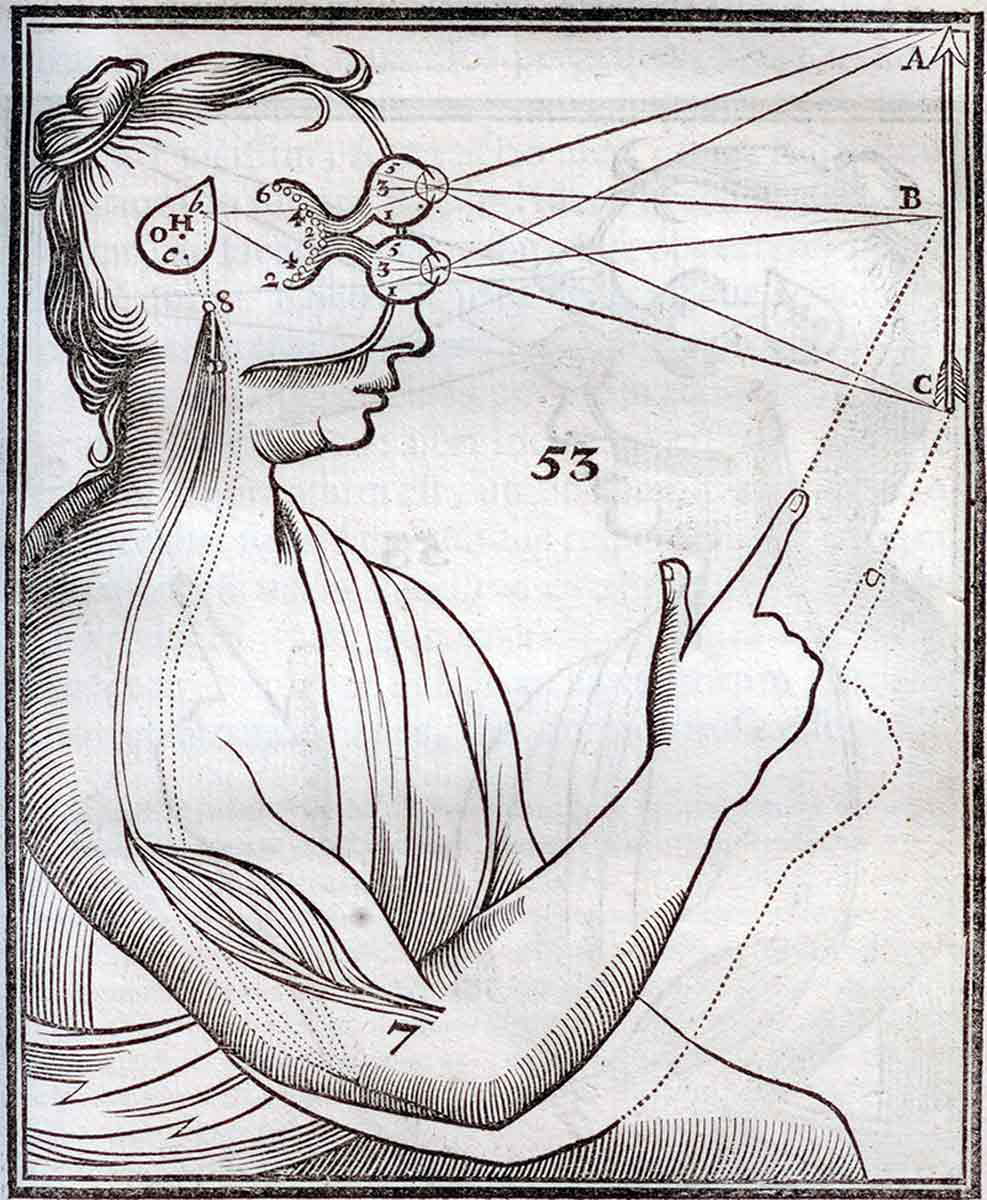
While arguments in favor of dualism have been made since at least the time of the Ancient Greek philosophers, modern dualism is widely considered to have emerged with René Descartes, who asserted that the mind is composed of something different from the physical matter of the body. In this view, the mind is made of mental substance while the body is made of physical substance.
This form of dualism is commonly referred to as substance or Cartesian dualism. However, it’s important to note that there are multiple perspectives on substance dualism, making Cartesian dualism the most accurate term when referring to Descartes’ ideas in particular.
One commonly referenced position in substance dualism is interactionism, which holds that the mind and body causally influence one another (Chalmers, 2002). For example, a racing heartbeat could lead to a mental state of anxiety, and vice versa. The biggest issue for interactionism is reconciling how a non-material mind can act upon a material body and how a material body could have any effect upon a non-material mind.
One method to deal with the seeming impossibility of a non-material mind causally acting upon a material body is to attribute its interplay to God. This is the view that Descartes ultimately espouses, making Descartes’ dualism an interactionist substance form. However, there’s also another form of dualism.
Property Dualism: How Mental States Emerge from the Brain
Epiphenomenalism holds that while the body can influence the mind, the mind cannot influence the body. This theory preserves our understanding of the laws of physics, such that some non-material objects cannot act upon a material one (Chalmers, 2002). This means that, according to epiphenomenalism, a racing heartbeat could induce a mental state of anxiety, but a mental state of anxiety cannot cause a heart to race.
This is a form of property dualism that proposes that, while the mind and body have different properties, there is only one substance: the physical. From these physical substances emerge mental phenomena, hence the name epiphenomenalism.
This position asserts that the mind and its accompanying mental activity are merely a side effect of the brain. The most difficult thing to reconcile in this form of property dualism is how mental states can have no effect on our bodies and, hence, on our behavior. It certainly seems that if you think, “I want to walk to the next room,” and you do so, your mental state of wanting to go to another room causes your subsequent action of walking to it.
Materialism & Behaviorism: Explaining the Mind Through Action
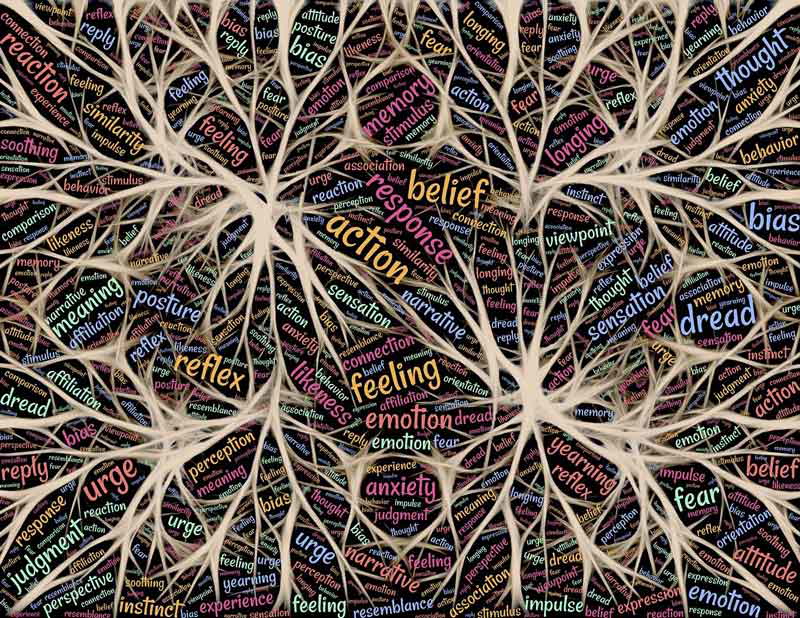
As noted above, epiphenomenalism poses problems for explaining behavior. One solution to this is materialist behaviorism. In materialism, no separate substance makes up the mind; there is only physical material in line with our current understanding of the universe.
Behaviorism (not to be confused with the behaviorism commonly referenced in psychology), as put forth by the philosopher Gilbert Ryle (1949), argues against dualism and ultimately concludes that dualists made a category mistake, ascribing some non-physical process to mental states.
To further elaborate on this supposed mistake, consider that while we can observe another person’s appearance, hear their voice, etc., we can never observe their thoughts. From that statement comes the conclusion that mental states are an internal process totally separate from our observable, physical world. But is this truly the case, or have mental states been confused with (as of right now) some unknown physical process?
Ultimately, Ryle’s behaviorism asserts that a mental state is associated with some behavior. For example, pain is the mental state associated with the behavior of wincing (Ryle, 1949).
An easy contradiction to this position is simply that people respond to the same thing differently. Person A might react to pain by wincing, while Person B remains stoic and shows no outward signs of distress. Someone might cry in response to sadness, while another cannot shed a tear. That said, materialism offers much more than just behaviorism.
Identity Theory: Are Mental States the Same as Brain States?
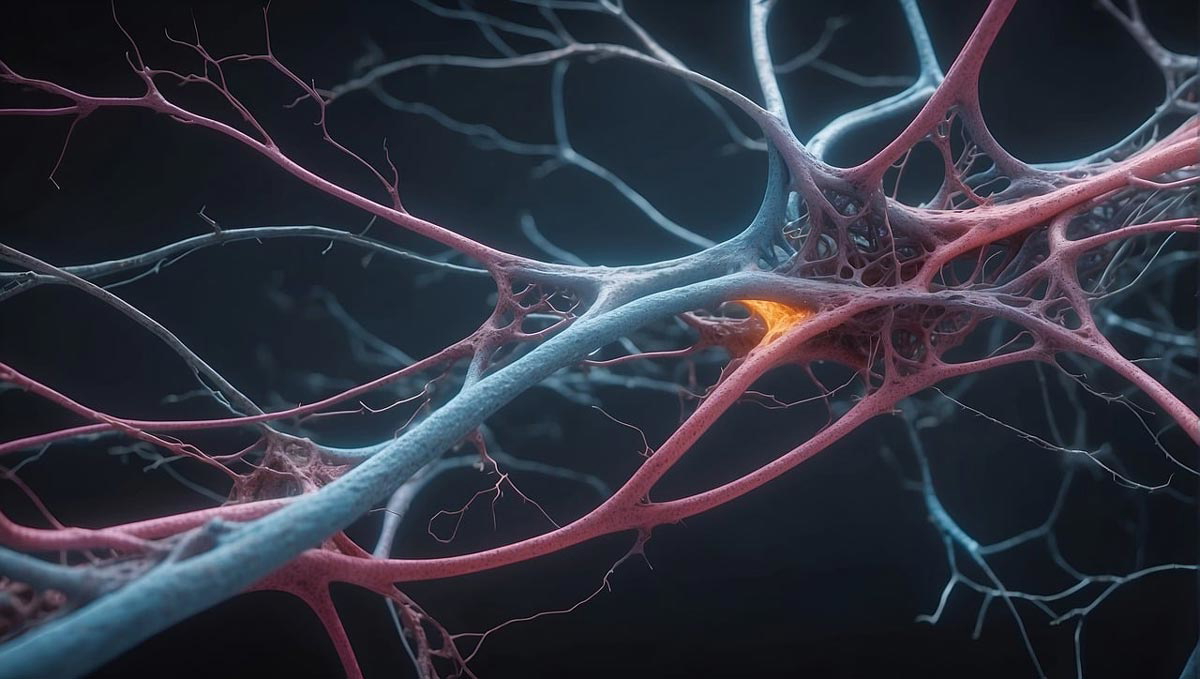
The identity theory was developed in the late 1950s, primarily by U.T. Place and J.J.C. Smart. In this theory, the mind and brain are the same, meaning mental states are identical to brain states.
The place used the example of seeing a green afterimage. This afterimage does not exist in the external world or literally in the brain. This leads to the phenomenological fallacy, which holds that because colors cannot be tied to brain processes, they are not a viable way to describe the mental state associated with the experience of color.
However, this amounts to equating descriptions of experiences with the phenomena themselves. How we commonly use language to talk about subjective experiences does not mean it accurately describes the process that produced said experience. In other words, just because we commonly talk about how we perceive things using similar terminology does not mean that those terms actually describe how our brains accomplish such perception.
Consider that the source of mental states can be discovered via scientific study. This aligns with modern neuroscience, which seeks to bridge mental states to neural activity via fMRI. For example, it is now known that the amygdala is the brain’s “fear center.” So, the identity theory appears to be a good contender for modern philosophy, but it is not without criticism.
The main objection to the identity theory is multiple realizability, which posits that mental states do not necessarily have a brain to exist. This ties in with the current debates about artificial intelligence and consciousness: Can a machine have a mind? If computers can create consciousness, then minds cannot be identical to brains, as they can be created using alternate methods.
Functionalism: Understanding the Mind as a System of Functions
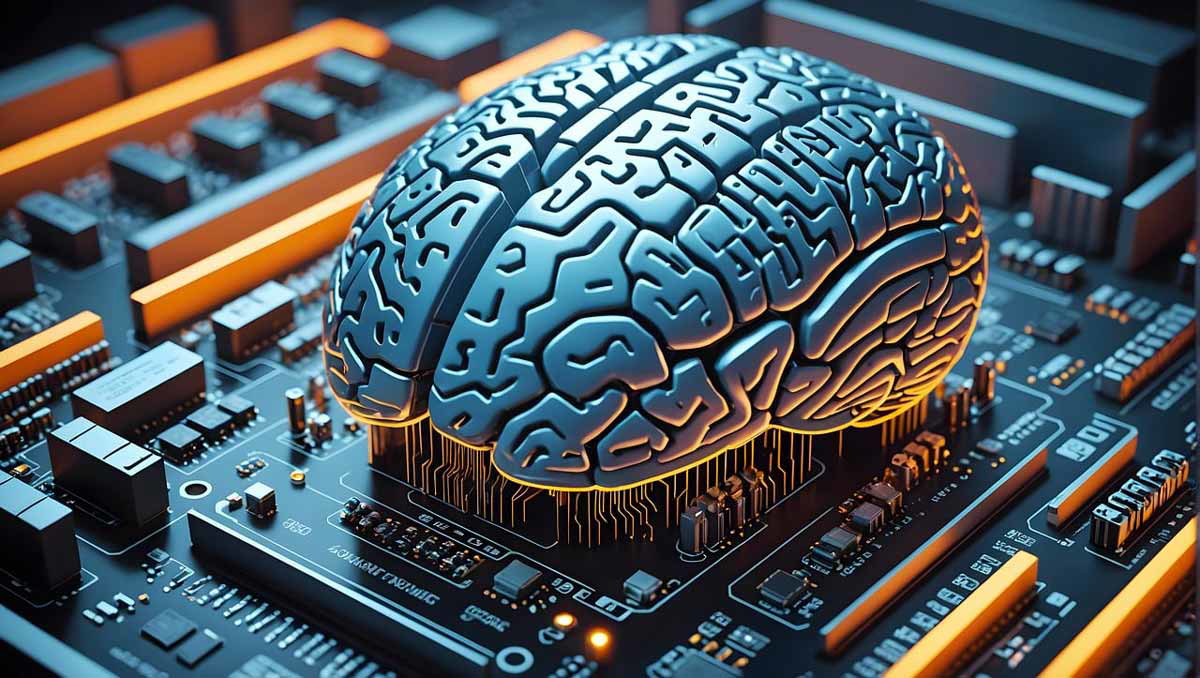
In the 1960s, philosophers Hilary Putnam, David Armstrong, and David Lewis each developed distinct forms of functionalism, the view that mental states are functional states within a system of cognition. Putnam argued for machine functionalism, suggesting that mental states are functions of a computational machine, thereby allowing them to be multiply realizable (Chalmers, 2002).
In theory, something other than a brain could possess mental states. This brings to mind current debates about artificial intelligence and consciousness. However, functionalism is not constrained solely to the computational kind.
Armstrong (1981) advocated for analytic functionalism, which aligns more with the above-mentioned identity theory. He suggested that if we can discover a brain state that can be shown to cause pain, then that brain state is, in fact, pain. In this view, mental states are brain states.
Lewis (1972) takes Armstrong’s approach further, suggesting that our common statements about mental states, if compiled, explain what it is to be in a given mental state. For example, there are ways humans generally talk about the experience of pain, and if all these statements were combined, the result would be the actual definition of the mental state of pain itself.
A major criticism of functionalism is that it cannot explain the qualitative experience of having a mental state. These qualitative experiences are often referred to as qualia in philosophy. Perhaps one of the most famous examples comes from Thomas Nagel’s (1974) essay “What Is It Like to Be a Bat?” which points out that even if we describe all the physiology behind a bat’s conscious experience, we’d still have no knowledge of what it is actually like to be one!
What Does the Mind-Body Debate Teach Us About Consciousness?

There are several ideas about what the mind is, how it works, and how it is even possible to have a mind in the first place. This article provides just a sample of the major theories in the philosophy of mind. As seen in the preceding content, the dualism-versus-materialism debate is much more complicated than simply comparing “the mind/soul is a separate entity from the body” and “all things, including the mind, are physical.” Many philosophers have put forth convincing and logical arguments, yet no one knows what the mind is today.
While the philosophy of mind’s biggest question is the hard problem of consciousness, this subspecialty explores many avenues.
References
Armstrong, D. M. (1981). The nature of mind. University of Queensland Press.
Chalmers, D. J. (2002). Philosophy of mind: Classical and contemporary readings. Oxford University Press, Inc.
Lewis, D. (1972). Psychophysical and theoretical identifications. Australasian Journal of Philosophy, p. 50. https://doi.org/10.1080/00048407212341301
Nagel, T. (1974). What is it like to be a bat? Philosophical Review, p. 83.
Place, U. T. (1956). Is consciousness a brain process? British Journal of Psychology, 47. https://doi.org/10.1111/j.2044-8295.1956.tb00560.x
Ryle, G. (1949). The concept of mind. University of Chicago Press.